Metabolic Limiters in Soccer: Beyond VO2 Max
VO2 Max testing in soccer doesn’t tell the whole story. Learn how portable metabolic testing uncovers true performance limiters on the pitch.

VO2 Max testing in soccer does not fully explain match performance or fatigue. The real metabolic limiters, ventilatory thresholds, repeat sprint recovery, and oxygen cost of acceleration, can only be identified through sport-specific, portable metabolic testing.
Elite soccer has evolved, testing protocols have too.
Table of Contents
The Myth of Lab Based VO2 Max as the Gold Standard
What VO2 Max Actually Measures
VO2 Max represents the maximal rate of oxygen consumption during incremental exercise. It reflects cardiovascular and aerobic capacity and is widely used in endurance sport performance evaluation.
Research consistently shows VO2 Max correlates with endurance performance (Bassett & Howley, ACSM Guidelines for Exercise Testing and Prescription).
In soccer however, the story is more complex.
Why VO2 Max Doesn’t Fully Explain Match Fatigue
Soccer is intermittent, not steady-state and includes:
- Repeated accelerations and decelerations
- Short recovery intervals
- Variable tactical movement patterns
- Frequent changes of direction
Two players with identical VO2 Max values can display dramatically different in-game endurance.
VO2 Max testing in soccer can fail to capture what limits performance in the individual athlete.
Learn from the experts – Metabolic Testing Interview for Coaches: How Field VO2 Data Transforms Training Decisions
The Modern Game Demands More Than Maximal Oxygen Uptake
Seasonal analysis has shown increased sprint density and reduced recovery time between high-intensity actions (Barnes et al., 2014, The Evolution of Physical and Technical Performance Parameters in the English Premier League, International Journal of Sports Medicine).
Acceleration Density
High metabolic cost is driven by repeated accelerations, not just top speed. Accelerations have a disproportionate oxygen demand compared to steady-state running.
Short Recovery Windows
Recovery between sprints relies heavily on aerobic efficiency below maximal capacity.
Tactical Movement Variability
Games and drills impose highly specific movement patterns that treadmill tests cannot replicate.
Discover how to coach to athlete potential, not burnout!
The Real Metabolic Limiters in Soccer
Portable metabolic testing on the pitch reveals what lab-based soccer performance testing often misses.
1. Low Ventilatory Threshold
A player may have high VO2 Max but a low VT1 or VT2 relative to match intensity. This means they rely on anaerobic metabolism earlier than ideal.
Result:
- Early fatigue
- Reduced repeatability
- Late-game drop-off
2. Poor Repeat Sprint Recovery
Repeat sprint recovery is largely aerobic-driven. If oxygen delivery and utilization between sprints is inefficient, performance degrades progressively.
3. High Oxygen Cost of Acceleration
Two players running identical distances may have different oxygen costs due to:
- Movement inefficiency
- Technical running mechanics
- Poor breathing mechanics
These individual differences are unknown without portable metabolic testing.
4. Inefficient Movement Economy
Running economy varies significantly across players. Soccer-specific economy differs from treadmill economy.
Sport-specific testing improves ecological validity.
Better specificity leads to more actionable insights for training methodology updates.

Key Differences: Lab vs On-Pitch Testing
| Variable | Lab Treadmill Test | On-Field Portable Testing |
|---|---|---|
| Movement Specificity | Linear, predictable | Multi-directional |
| Tactical Context | None | Game-realistic |
| Acceleration Load | Minimal | High |
| Repeat Sprint Demand | Low | High |
| Return-to-Play Validation | Limited | Sport-specific |
Why Traditional Lab Testing Misses These Limiters
Most metabolic carts such as Cosmed, Parvo and Cortex are lab-dependent systems designed for controlled indoor environments.
They are excellent for clinical CPET and steady-state assessment, but they cannot replicate:
- Varied running strides or speed during drills
- Tactical movement variability on the pitch
- Surface, environment and equipment specific mechanics
Why Elite and Pro Sports Teams Use Portable Metabolic Testing
Portable metabolic testing allows real-time sport specific oxygen measurement during:
- Tactical drills
- Conditioning blocks
- Return-to-play metrics
- Recruiting drills
Position-Specific Oxygen Cost
Compare your midfielders, forwards and defenders during drills.
Return to Play Assessment
Ensure post-injury athletes can tolerate true match-intensity metabolic loads.
Coach with real physiological insights.
Book a demo and discover how portable metabolic testing reveals what’s limiting your players.
Implementation Strategy for Performance Professionals
- Standardize a baseline graded exercise test.
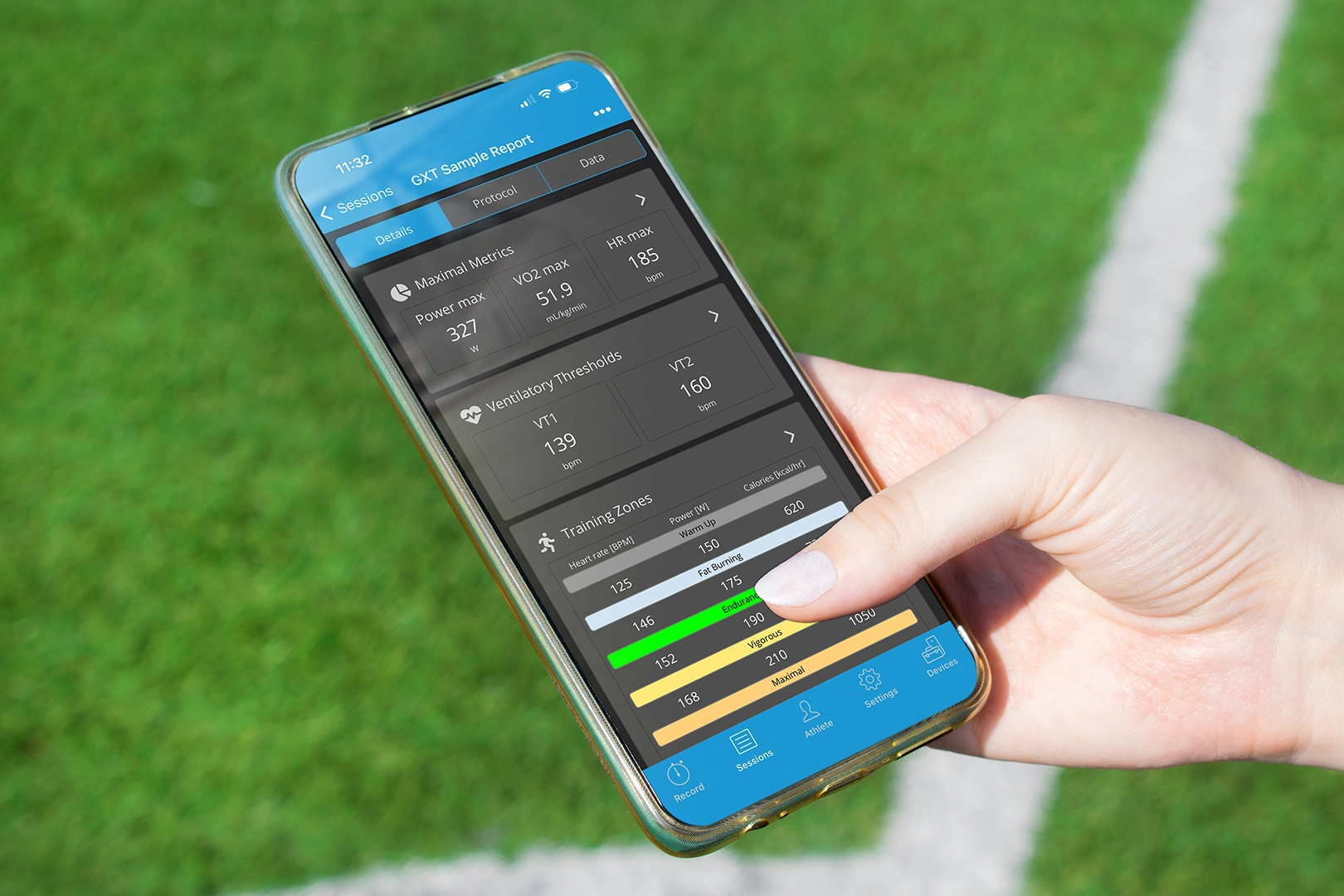
- Detect ventilatory thresholds and zones.
- Conduct position-specific testing.
- Compare oxygen cost across roles.
- Track repeat sprint recovery progression.
- Integrate findings into conditioning plans.
Portable metabolic testing connects physiology to performance.
It helps identify the true limiters in each athlete.
Discover the importance of VO2 max testing in the field
Why This Matters for Serious Recreational Soccer Players
The hidden metabolic limiters in soccer are not exclusive to professional environments.
Competitive adult leagues, semi-pro clubs, university programs, and high-performance recreational teams face the same physiological constraints:
- Repeated sprint demands
- Acceleration-heavy play
- Short recovery windows
- Tactical variability
- Late-game fatigue
The difference?
Recreational players often have less structured conditioning and less physiological insight.
The Common Scenario
A 45-year-old competitive league midfielder:
- Trains twice per week
- Plays one intense weekend match
- Maintains good general fitness
- Has a “solid” VO2 Max score
Yet consistently fades in the final 20 minutes.
Why?
Because match fatigue in soccer is rarely about maximal oxygen uptake alone.
It’s often:
- A ventilatory threshold that sits too close to match intensity
- Poor aerobic recovery between high-intensity bursts
- Elevated oxygen cost due to inefficient movement mechanics
- Reduced repeat sprint recovery capacity
These limiters are invisible in standard fitness testing.
Longevity, Not Just Performance
For serious recreational players, metabolic profiling offers another advantage:
Longevity.
With age, recovery dynamics shift. Aerobic efficiency becomes more important than raw maximal capacity. Tracking VT1 / VT2 changes, aerobic repeatability and position-specific oxygen cost allows adult players to:
- Train smarter
- Avoid unnecessary fatigue accumulation
- Reduce injury risk from metabolic overload
- Extend competitive performance into the future
Portable metabolic testing makes this accessible outside professional clubs.
The same tools used by leading coaches can now support high-level recreational athletes who take performance seriously.
Are you a soccer player looking to get tested?
Find a location on the VO2 Master facility finder
Conclusion
Elite soccer performance is multi-dimensional.
VO2 Max is important, but thresholds, repeat sprint recovery, and oxygen cost often determine match fatigue.
Portable metabolic testing provides the sport-specific insight required to identify these limiters.
What’s actually limiting your players’ performance? Unlock it with portable metabolic testing.
Frequently Asked Questions
1. Is VO2 Max still important in soccer?
Yes, but it’s only one metric. Thresholds, submax testing and test-retest repeatability during sport specific movement provide key insights into an athlete’s metabolic profile and performance.
2. Can portable testing be used during games?
It is used during training sessions or simulated match conditions to prevent damage to the device.
3. How does this differ from GPS?
GPS tracks movement; metabolic testing measures physiological cost and shows VO2, heart rate, ventilation, respiratory frequency, tidal volume and more.
4. Is it safe for return-to-play athletes?
Yes, when conducted under professional supervision.
5. What pro soccer/football teams are using the VO2 Master?
Similar to pro hockey, basketball and North American football teams, we do not share the names of any of our professional team customers if they have not publicly promoted testing with VO2 Master.
6. How often should teams test?
Pre-season baseline, mid-season monitoring, and post-injury validation. Many athletes are tested sub maximally before and after changes to their training programs throughout the year.