The Challenge
HYROX is a relatively new endurance-strength racing format that blends repeated running segments with demanding functional workout stations. Despite its growing popularity, little physiological data exists from elite athletes during a full race simulation especially under real competition-like conditions.
To better understand the demands of the sport and what separates the very best athletes from other elite endurance competitors, MKL Training conducted one of the first detailed in-field metabolic analyses of a HYROX champion, using the VO2 Master analyzer and lactate testing during actual race movements.
The goal was simple but ambitious: Measure real-time physiology throughout an entire HYROX race structure, something that previously was impossible with traditional metabolic analyzers.
The test focused on Alexander Roncevic, former HYROX world champion and current Men’s PRO world record holder (53:15, Hamburg). The goal was to analyze how his body responds metabolically during a full race simulation and identify key performance drivers.
The assessment was conducted in May 2025 at Zone.Fit in Vienna, Austria with the VO2 Master analyzer and lactate testing using official HYROX Open weights.
Test Setup
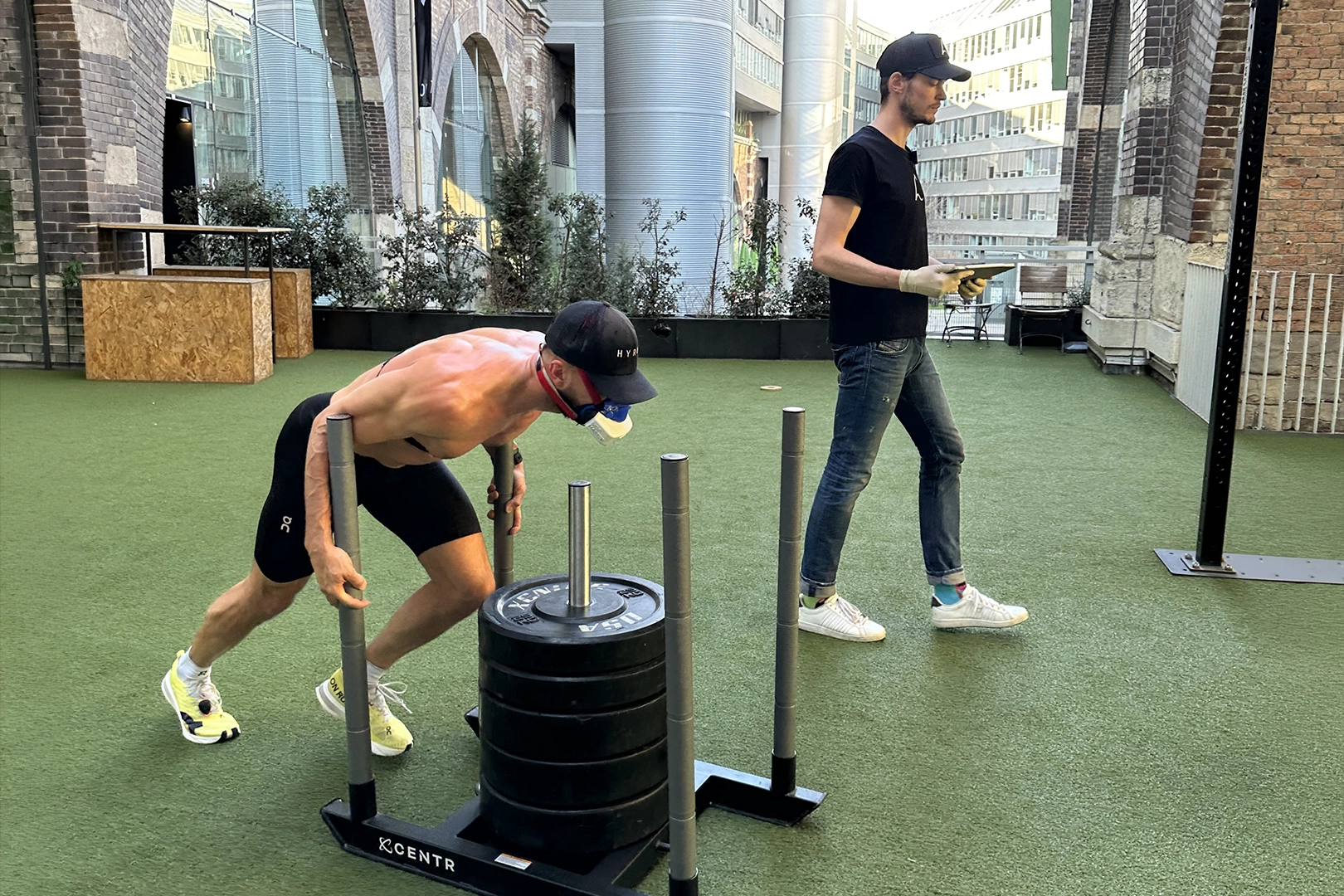
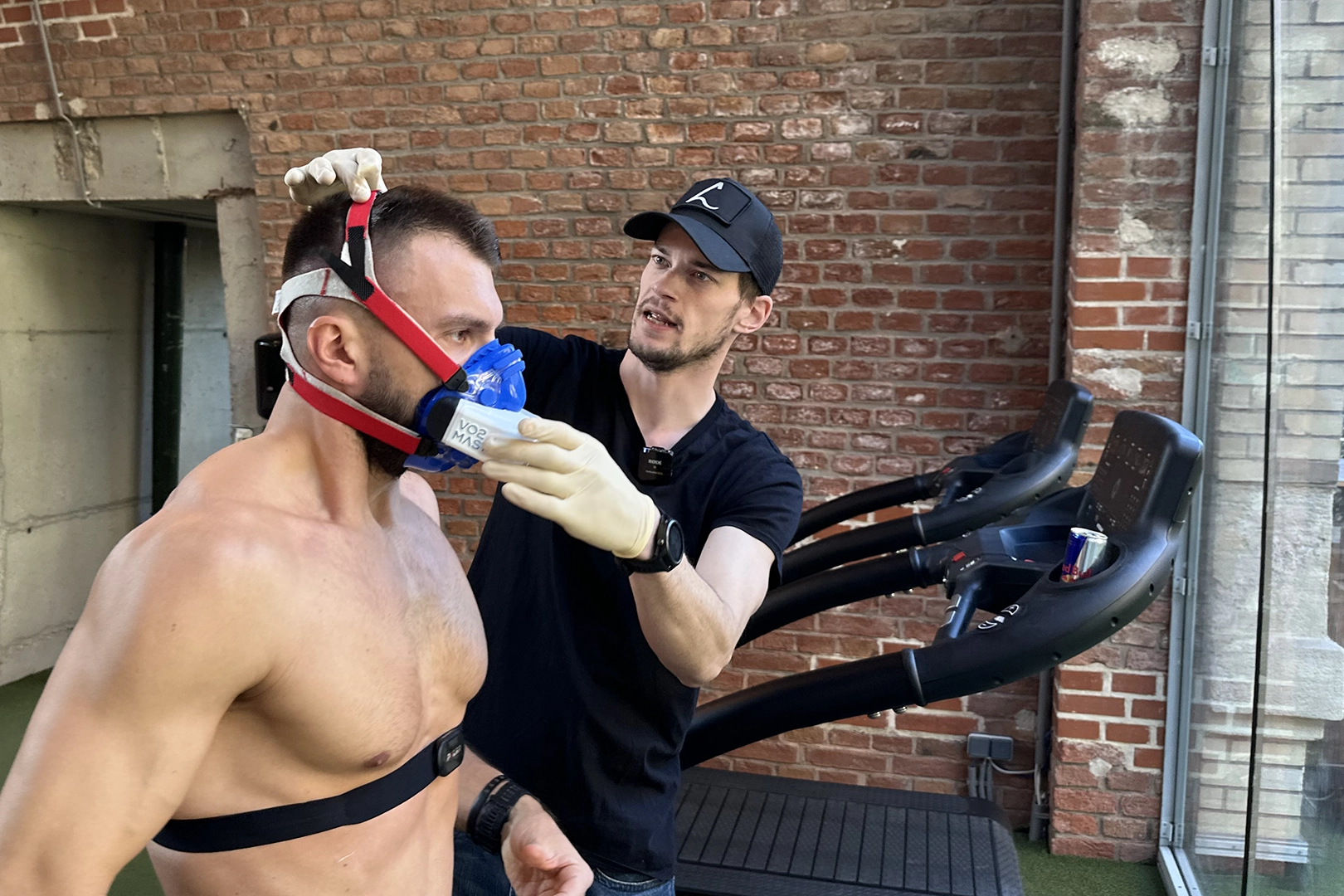
To replicate the demands of competition as closely as possible, Alexander completed a full HYROX race simulation while being continuously monitored with the VO2 Master portable metabolic analyzer.
Run → SkiErg → Run → Sled Push → Run → Sled Pull → Run → Burpee Broad Jumps → Run → RowErg → Run → Farmers Carry → Run → Lunges → Run → Wall Balls
Measurements included:
- VO2 (oxygen consumption)
- Ventilation and breathing patterns
- Breathing frequency
- Blood lactate
- Heart rate
- Running pace and segment splits
The analysis provided a complete metabolic profile across every run and workout station of the race.
The Solution: Truly Portable Technology
This project was only possible because of the portability and accuracy of the VO2 Master analyzer.
Massimo Köstl-Lenz
Traditional metabolic testing typically requires a laboratory environment and cannot capture the dynamic demands of a full race simulation. Using the VO2 Master analyzer enabled:
- Real-world testing during a full HYROX race simulation
- Continuous metabolic data across both running and workout stations
- High-quality insights without restricting movement or performance
- Data collection in a true sport-specific environment
This allowed MKL Training to observe how an elite athlete’s physiology behaves under realistic competition conditions, rather than in isolated lab protocols.
Simulation Results
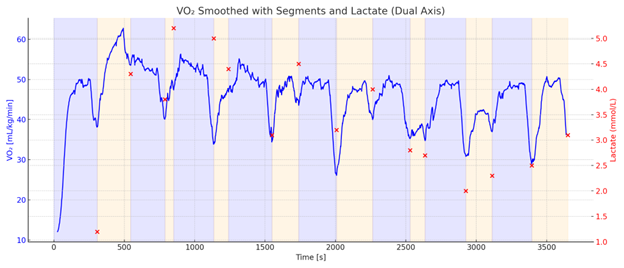
Above is the time series from the simulation showing oxygen consumption and lactate across the entire event.
- Blue curve: VO2 (oxygen uptake)
- Red markers: lactate measurements
- Alternating shaded blocks: HYROX race segments (runs and workouts)
Key Observations and Insights
1. Moderate lactate despite high workload
Throughout the simulation, lactate values ranged roughly between ~1 and ~5 mmol/L.
This is relatively moderate compared with other high-intensity sports such as sprint swimming, track sprinting or certain CrossFit workouts where lactate can exceed 10–20 mmol/L.
Even during demanding stations like: SkiErg, Sled Push, Burpee Broad Jumps
lactate increases were controlled, suggesting a highly efficient metabolic system.
Importantly, Alexander reported performing the simulation at approximately 75–85% perceived race intensity.
2. Workout stations drive metabolic demand
From the VO2 curve and lactate measurements, a clear pattern emerges:
- VO2 typically increases during workout stations
- Lactate rises after most stations
- During runs, both VO2 and lactate often stabilize or decline
This indicates: HYROX workouts require higher energy turnover and running segments allow the athlete to restore metabolic balance. This means that for an elite HYROX athlete like Alexander, running acts partially as a recovery modality within the race.
3. Increasing efficiency during the second half of the race
One of the most striking findings was that oxygen consumption decreased in the second half of the simulation, despite: constant pacing, a stable perceived effort and an unchanged race structure.
In other words, Alexander became more economical as the race progressed.
This efficiency improvement was visible in: VO2 trends, respiratory efficiency metrics, his stable breathing frequency despite fluctuating ventilation.
This is a hallmark of elite endurance-hybrid performance.
4. Ventilation driven by deeper breathing, not faster breathing
Another interesting physiological pattern:
When ventilation increased, it was mostly due to greater tidal volume (deeper breaths) rather than a higher breathing frequency.
Breathing frequency remained relatively stable throughout the race.
This suggests a strong respiratory efficiency and excellent control of physiological stress during high-intensity hybrid exercise.
5. Effort level relative to VO2 Max
Alexander’s VO2 Max is ~72 ml·kg⁻¹·min⁻¹
During most of the simulation his oxygen consumption remained below ~75% of VO2 Max.
This confirms that HYROX, even at elite level, is primarily an endurance-dominated event lasting roughly one hour rather than a near maximal metabolic effort.
The Impact: Integrating metabolic testing into real race simulations
These results provide a much clearer picture of how athletes perform under sport-specific conditions. Instead of relying solely on laboratory VO2 Max tests, coaches and athletes can now analyze:
- Race-specific energy demands
- Efficiency under fatigue
- Pacing strategies
- Physiological strengths and limitations
Such insights are particularly valuable in emerging sports like HYROX, where performance models are still being defined.
To further contextualize the results, the same simulation protocol was also conducted with Franz Löschke, a former professional triathlete. Despite having exceptional endurance and faster raw running speed, Alexander Roncevic showed:
- Lower oxygen consumption across segments
- Lower lactate accumulation during key stations
- Greater efficiency in the second half of the race
This comparison highlighted how sport-specific adaptation and metabolic efficiency can outperform raw endurance capacity in HYROX.
Key Takeaway
The testing revealed to coach Massimo important insights into what makes a world-class HYROX athlete exceptional.
While many endurance athletes rely on a very large aerobic engine (high VO2 Max), Alexander’s performance stood out primarily due to efficiency and metabolic control throughout the race.
These findings help explain why athletes like Alexander can maintain performance deep into the race while others begin to fatigue.
Portable metabolic technology now makes it possible to analyze these factors directly within realistic competition scenarios-providing athletes, coaches, and researchers with valuable insights into performance in modern hybrid endurance sports.
This study was conducted by MKL training http://www.mlk-training.at in cooperation with the team at Rework.
Article author: Nancy Phillips, Kinesiologist, MBA